 youthpublishnow@gmail.com
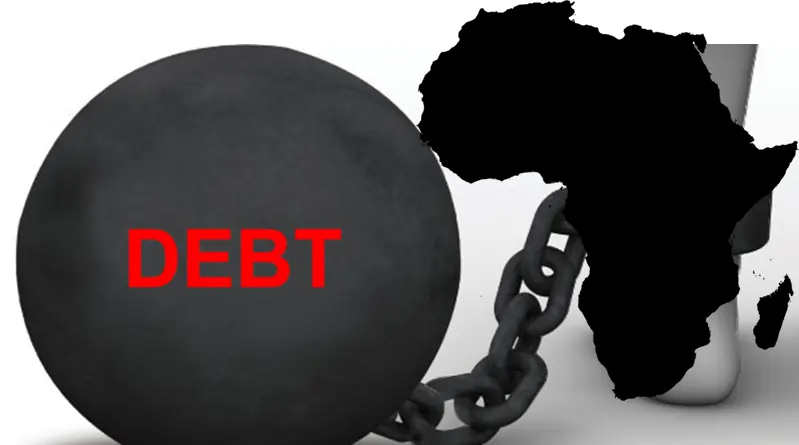
Africa’s entered 2026 carrying the heaviest debt burden in its post-independence history, and the simultaneous collapse of U.S. foreign aid and the global energy shock triggered by the Iran war has turned what was already a structural crisis into an acute emergency across dozens of nations.
Twenty-two low-income countries in Sub-Saharan Africa currently sit in or at high risk of debt distress, according to World Bank classification. These governments now face an impossible arithmetic: service foreign debt, fund basic government operations, and absorb energy cost shocks that arrived without warning when the Strait of Hormuz closed in early March 2026.
The Trump administration’s shutdown of USAID and the broader withdrawal of U.S. development assistance have removed a critical financial buffer at precisely the wrong moment. African nations that depended on American aid for health systems, food programs, and infrastructure development are now scrambling to replace billions of dollars in annual flows with no viable alternative at the same scale.
China remains the continent’s largest bilateral financier. Beijing’s zero-tariff policy for African products and its continued appetite for large-scale infrastructure deals have kept Chinese investment flowing. But Chinese financing comes with its own debt structures, and critics warn that replacing American aid with Chinese loans simply trades one form of dependency for another, while increasing long-term debt obligations on already stressed balance sheets.
Africa’s projected average GDP growth of 4.3% in 2026 looks increasingly optimistic against this backdrop. High debt servicing costs divert money from schools, hospitals, and job creation. Tight global credit conditions make new borrowing expensive. Inflationary pressures, partly driven by the global oil crisis and partly by currency depreciation against the U.S. dollar, are eroding household purchasing power across the continent.
In Nigeria, the NNPC signed a major MOU with Chinese firms to restart the Port Harcourt and Warri refineries, a development that could reduce the country’s fuel import bill but will take years to deliver results. Dangote Refinery, which recently confirmed it tested at 661,000 barrels per day during commissioning, exceeding its nameplate capacity, offers Nigeria’s best near-term hedge against global oil price shocks. But the refinery’s benefits flow primarily to domestic fuel supply, not to the broader fiscal crisis.
In South Africa, the government declared severe storms a national disaster on May 11, adding infrastructure repair costs to a government already stretched by coalition politics and sluggish growth. South Africa’s local elections later in 2026 will provide the first real read of public sentiment since the Government of National Unity formed in 2024.
In Kenya, President Ruto’s government signed 11 deals with France covering rail, ports, energy, and the digital economy, signaling Nairobi’s determination to diversify its partnerships. A new LPG terminal in Mombasa, backed by Tanzanian billionaire Rostam Aziz, will break a near-monopoly on cooking gas imports and could meaningfully reduce household energy costs in East Africa.
In the Sahel, the situation carries humanitarian dimensions beyond economic stress. Mali, Burkina Faso, and Niger, all under military juntas, rely on Russian Africa Corps for security. The al-Qaeda-linked JNIM has blockaded Mali’s oil supply routes. Armed groups have cut off food and basic supplies in parts of Burkina Faso. The humanitarian situation in the region deteriorated throughout the first quarter of 2026 and shows no signs of stabilizing.
Read More: Trump’s $170 Billion Immigration Crackdown Escalates in 2026 as Deportations Surpass 2.5 Million
The African Union’s credibility as a coordinating institution faces its own stress test. A divided AU has struggled to assert collective leadership at precisely the moment when transnational crises demand it. Civic organizations and regional institutions have stepped in to maintain electoral oversight and humanitarian response, but they cannot substitute for coherent political leadership at the continental level.
Africa’s path forward runs through three requirements that currently exist more in aspiration than in policy: domestic revenue mobilization to reduce aid dependency, homegrown debt restructuring mechanisms that operate independently of Western credit agencies, and regional energy cooperation that reduces exposure to global supply shocks. The G20’s Africa High-Level Dialogue on Debt Sustainability is pushing in this direction, but the pace of reform lags far behind the pace of the crisis.


 Mael Jules
 youthpublishnow@gmail.com